https://www.wealthyaffiliate.com?a_aid=18e69c44
Introduction
Starting an affiliate marketing business can feel overwhelming.
You need a website, content, keywords, images, analytics, email marketing, affiliate links, and a way to understand whether your efforts are producing results.
Fortunately, you do not need dozens of expensive tools to get started.
The best affiliate marketing tools for beginners are the ones that simplify essential tasks, save time, and help you make better decisions. A small collection of dependable tools is usually more valuable than a complicated stack you do not fully understand.
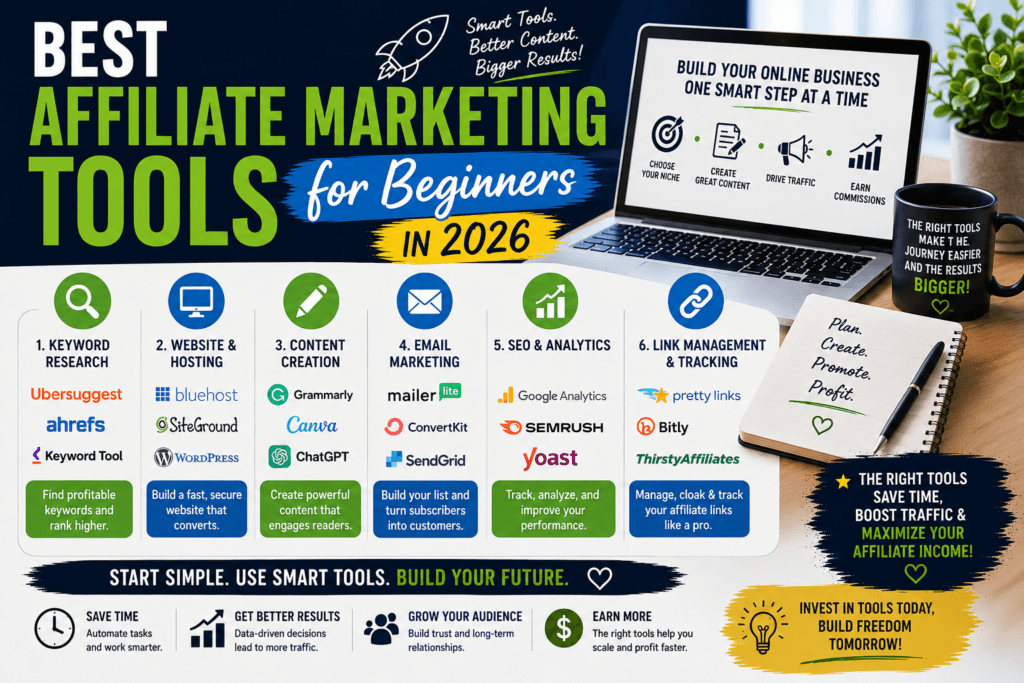
In this guide, we’ll explore practical tools that can help beginners build, manage, and grow an affiliate marketing website in 2026.
Quick Comparison of the Best Affiliate Marketing Tools
| Tool | Primary Purpose | Best For |
|---|---|---|
| Wealthy Affiliate | Training, hosting, research, and support | Beginners seeking an all-in-one platform |
| WordPress | Website and content management | Publishing affiliate content |
| Google Search Console | Search performance and indexing | Understanding Google visibility |
| Google Analytics | Traffic and visitor analysis | Measuring website activity |
| Google Trends | Topic and trend research | Comparing audience interest |
| Rank Math | WordPress SEO | Optimizing articles and sitemaps |
| Canva | Graphic design | Blog and social-media images |
| MailerLite | Email marketing | Building an email audience |
| Microsoft Clarity | Visitor-behavior analysis | Heatmaps and session recordings |
| Pretty Links | Affiliate-link management | Organizing and updating links |
1. Wealthy Affiliate: Best All-in-One Platform for Beginners
Wealthy Affiliate is designed for people who want to learn how to build an online business while having many of the necessary resources in one place.
Its platform currently combines step-by-step training, website hosting, AI-powered tools, research resources, support, and an online community. It also provides a way to begin exploring the platform without immediately entering credit-card information. You can verify the latest offerings on the official Wealthy Affiliate website.
Why It Can Help Beginners
New affiliate marketers often struggle because they must assemble training, hosting, keyword research, website tools, and support from several different providers.
An all-in-one environment can reduce that confusion.
Wealthy Affiliate may be particularly useful if you:
- Are completely new to affiliate marketing
- Want structured, step-by-step training
- Need help building your first website
- Prefer having research and website tools together
- Want access to a community where you can ask questions
- Need technical or educational support
Important Consideration
Wealthy Affiliate is not an automated income system.
The platform provides education, tools, and support, but users must still research topics, create valuable content, develop skills, and remain consistent.
It is best viewed as a business-building environment—not a shortcut to guaranteed results.
2. WordPress: Best Tool for Building an Affiliate Website
WordPress is an open-source content-management system used to create blogs, business websites, stores, and many other types of online properties.
It gives website owners access to customizable themes, block-based editing, and an extensive collection of plugins. The official WordPress website describes the platform as flexible enough to build and extend websites without requiring users to code everything themselves.
Why It Works Well for Affiliate Marketing
WordPress makes it possible to:
- Publish blog posts and product reviews
- Build category and comparison pages
- Add affiliate links
- Create navigation menus
- Optimize content with SEO plugins
- Add email forms and analytics
- Schedule and update articles
- Maintain control over your content
WordPress itself is free, but you will normally need a domain name and hosting unless those services are included with another platform you use.
Beginner Tip
Avoid installing a plugin for every small feature.
Too many plugins can complicate website management and potentially affect performance. Begin with only the tools your website genuinely needs.
3. Google Search Console: Best Tool for Monitoring Google Visibility
Google Search Console helps website owners understand how their content appears in Google Search.
Its reports can show search impressions, clicks, indexing information, page-related issues, and other performance data. Google’s Search Console documentation explains how its reports help website owners monitor search performance and indexing.
Useful Search Console Features
Beginners can use it to:
- Discover which search queries produce impressions
- See which pages receive clicks
- Monitor average search positions
- Determine whether Google has indexed a page
- Submit and monitor a sitemap
- Inspect individual URLs
- Identify certain mobile or performance issues
The URL Inspection tool can also provide information about Google’s indexed version of a page and help determine whether a URL may be indexable.
Why This Tool Matters
Without Search Console, you may be publishing content without knowing whether Google is finding it.
Even when an article is not receiving many clicks, impressions can show that it is beginning to appear for certain searches. Those early signals can help you improve titles, expand sections, and identify future content opportunities.
4. Google Analytics: Best Tool for Understanding Website Traffic
Google Analytics helps you understand what happens after visitors arrive at your website.
Its reports can monitor traffic, traffic sources, landing pages, visitor activity, and engagement. According to Google’s Analytics reporting guide, the platform collects website and app data to provide insights into visitors and their activity.
Questions Google Analytics Can Help Answer
- How many people visit the website?
- Where does the traffic come from?
- Which pages attract the most visitors?
- How long do people engage with the site?
- Which landing pages perform best?
- Are visitors taking important actions?
Search Console vs. Google Analytics
These tools serve different purposes.
Google Search Console primarily shows how your website performs within Google Search.
Google Analytics helps explain what visitors do after reaching your website.
Using both provides a more complete view of your affiliate marketing progress.
5. Google Trends: Best Free Tool for Comparing Topic Interest
Google Trends allows you to compare interest in topics and search terms across different periods and locations.
The Google Trends Explore tool shows relative search interest by time, location, and popularity.
How Affiliate Marketers Can Use It
You can use Google Trends to:
- Compare two niche ideas
- Identify seasonal topics
- See whether interest is rising or declining
- Explore regional differences
- Discover related topics
- Plan timely content
For example, an affiliate marketer in the outdoor niche could compare interest in hiking equipment, camping gear, and portable power stations.
Important Limitation
Google Trends does not replace traditional keyword research.
Its numbers represent relative interest rather than guaranteed monthly search volume. Use it to recognize patterns and compare topics—not to predict exact traffic.
6. Rank Math: Best WordPress SEO Assistant
Rank Math is a WordPress plugin that helps website owners manage common on-page SEO tasks.
Depending on the version and settings being used, it can help with titles, meta descriptions, indexing controls, schema, redirects, and XML sitemaps. Rank Math’s official sitemap guide explains how its sitemap features help search engines navigate website content.
Why Beginners May Find It Helpful
Rank Math provides prompts and settings that can remind you to consider:
- The primary keyword
- SEO titles
- Meta descriptions
- Internal and external links
- Image alt text
- Content structure
- Sitemap settings
Important Reminder
An SEO score is not a guarantee that an article will rank.
Use the plugin as a checklist, but continue writing naturally for readers. Helpful content, search intent, authority, originality, and reader satisfaction matter more than achieving a perfect plugin score.
You generally need only one primary SEO plugin. Installing multiple SEO plugins can create conflicting settings.
7. Canva: Best Tool for Creating Website and Social-Media Graphics
Strong visuals can make affiliate content more engaging and easier to share.
Canva offers templates, photo-editing features, graphics, icons, video tools, and a combination of free and premium assets. Its official features page covers its current design and editing capabilities.
Affiliate marketers can use Canva to create:
- Featured blog images
- Facebook graphics
- Pinterest pins
- Instagram posts
- YouTube thumbnails
- Comparison charts
- Lead magnets
- Simple logos
- Product-review graphics
Beginner Tip
Create a consistent visual identity.
Using similar colors, fonts, image dimensions, and design elements can make your content more recognizable across your website and social platforms.
Before using any image or asset commercially, confirm that its license permits your intended use.
8. MailerLite: Best Beginner-Friendly Email Marketing Tool
Search and social-media traffic can fluctuate, but an email list gives you a direct way to reconnect with interested readers.
MailerLite provides email campaigns, signup forms, landing pages, and automation features. Its official free-plan page states that beginners can access essential tools such as forms, landing pages, and automation, although plan limits and features can change.
Ways Affiliate Marketers Can Use Email
- Send new article notifications
- Deliver a free guide or checklist
- Share educational email sequences
- Recommend relevant resources
- Reintroduce updated content
- Build long-term reader relationships
Avoid Constant Promotion
People do not join an email list simply to receive sales messages.
Provide useful tips, insights, and resources regularly. Affiliate recommendations should fit naturally within the value you deliver.
9. Microsoft Clarity: Best Tool for Seeing How Readers Use Your Website
Analytics reports provide numbers, but they do not always show why visitors behave a certain way.
Microsoft Clarity provides heatmaps and session recordings that can reveal where users click, how far they scroll, and where they may encounter problems. Microsoft currently describes Clarity as a free visitor-behavior analytics tool with session recordings and heatmaps.
Clarity Can Help You Discover
- Whether readers reach your CTA
- Where visitors stop scrolling
- Which links receive attention
- Whether a page creates confusion
- Which page elements are ignored
- Where users experience friction
Always configure analytics and recording tools carefully, follow applicable privacy requirements, and avoid collecting information you do not need.
10. Pretty Links: Best Tool for Managing Affiliate Links
As an affiliate website grows, managing links manually becomes increasingly difficult.
A link-management plugin can organize affiliate URLs in one location, making them easier to update when a merchant changes its destination page.
Pretty Links currently provides WordPress-based link management, redirects, tracking, and other affiliate-focused features. Availability can depend on the plan, so check its official features page before choosing a version.
Why Centralized Link Management Matters
Imagine using the same affiliate link in 30 articles.
If the merchant changes the destination, editing every article individually would be time-consuming. A centralized system may allow you to update the destination once.
Important Affiliate-Link Warning
Some affiliate programs restrict link shortening, cloaking, redirects, or modifications.
Always review each program’s terms before changing how its links appear or function.
A Simple Beginner Tool Stack
You do not need to use every tool immediately.
Stage One: Build the Foundation
Start with:
- A learning and hosting platform
- WordPress
- One SEO plugin
- Google Search Console
- A basic design tool
Stage Two: Understand Your Visitors
Add:
- Google Analytics
- Microsoft Clarity
Stage Three: Build an Audience and Monetize Efficiently
Consider:
- An email marketing platform
- Affiliate-link management
- More advanced keyword or research tools
This gradual approach keeps your expenses and learning curve under control.
How to Choose the Right Affiliate Marketing Tools
Before paying for any tool, ask:
- What specific problem will this solve?
- Do I already own a tool that performs this function?
- Is there a free version I can test?
- Will I use it regularly?
- Will it save meaningful time?
- Can my current business justify the expense?
- Is the tool appropriate for my level of experience?
Never buy software simply because a successful marketer recommends it.
A tool should support your strategy—not become the strategy.
Common Tool-Related Mistakes
Avoid:
- Buying too many subscriptions
- Constantly switching platforms
- Installing unnecessary WordPress plugins
- Trusting automated SEO scores completely
- Collecting data without reviewing it
- Using AI-generated content without fact-checking
- Ignoring affiliate-program link rules
- Expecting software to replace consistency
The best tool is often the one you understand well enough to use consistently.
Final Thoughts
Affiliate marketing tools can make website building, research, content creation, SEO, email marketing, and performance analysis more manageable.
But tools do not create a successful affiliate business by themselves.
Success still depends on choosing a focused niche, understanding your audience, publishing genuinely helpful content, earning reader trust, and improving your website over time.
Begin with the essentials. Learn what each tool does. Add new tools only when your business develops a clear need for them.
A simple, dependable toolkit—combined with patience and consistent action—is more powerful than an expensive collection of software you rarely use.
Ready to Start Building Your Affiliate Marketing Business?
Choosing the right tools is only one part of creating a sustainable affiliate website.
Read our complete guide, How to Start Affiliate Marketing with No Money in 2026, to learn how to choose a niche, build your website, create helpful content, attract visitors, and work toward your first affiliate sale.
If you prefer having structured training, website tools, hosting, research resources, and community support in one environment, explore Wealthy Affiliate and decide whether its approach fits your business goals.
- The right platform cannot guarantee success—but it can give you a clearer place to begin.